AI Won't Build Bigger Companies — It'll Build a Million Competitors to Yours
- Published
- Reading
- 5 min read
- Written by
- Nicolas SiatrasCEO & Founder
I've been writing code for 43 years. I've built Facebook games that hit 10 million monthly users, algorithmic trading systems where I wrote every line myself, and AI pipelines that generate thousands of structured outputs for $3. I've watched industries shift before — from the inside, not the sidelines.
What's happening right now with AI isn't what most people think.
The dominant narrative says AI is a tool for consolidation. Big companies get bigger. They have the data, the compute, the talent. Everyone else gets squeezed out. It sounds logical. It's also wrong.
AI won't consolidate industries. It will fragment them.
An Economist Saw This Coming in 1865
In 1865, William Stanley Jevons noticed something that didn't make sense. James Watt's steam engine was dramatically more efficient than its predecessors. You'd expect coal consumption to go down. It went up — about ninefold between 1801 and 1864, by Jevons's own figures.
Why? Because cheaper coal-per-unit-of-work made coal viable in places it had never been before. New applications appeared. Demand exploded and overwhelmed the efficiency savings.
This became known as Jevons Paradox: when the cost of a resource drops, total consumption increases — because latent demand that was priced out suddenly becomes viable.
Cloud computing did the same thing. Before AWS, provisioning a server meant buying hardware, racking it, waiting weeks, spending thousands. After: spin one up in minutes for pennies. Total server usage didn't decrease — it exploded by orders of magnitude. Millions of applications that were never worth building got built.
The pattern is always the same. The cost drops. The "worth doing" threshold drops with it. Latent demand floods in. Total output explodes.
AI is about to do this to the cost of building software. And legal services. And architecture. And marketing. And every knowledge-intensive industry where the work is expensive because of human labor.
You've Already Seen This Movie
Think about YouTube.
Before YouTube, producing video content meant studios, crews, editors, distribution deals. The cost was so high that only content serving massive audiences was viable. A show needed millions of viewers to justify its existence.
YouTube collapsed the production cost. And a million channels appeared — not competing with CNN, but serving audiences CNN would never serve. The guy teaching Uzbek pottery techniques to 400 subscribers. The woman explaining niche tax law for freelance illustrators to 2,000 viewers.
Those audiences always existed. The 400 people interested in Uzbek pottery were always there. But no production model could serve them economically. The cost was too high, the audience too small. So the content simply didn't exist.
YouTube didn't create demand. It made it economically rational to serve demand that was always there.
The Software Example Nobody's Talking About
There are more than 36 million small businesses in the United States. The vast majority have zero custom software. They run on spreadsheets, generic tools, and workarounds.
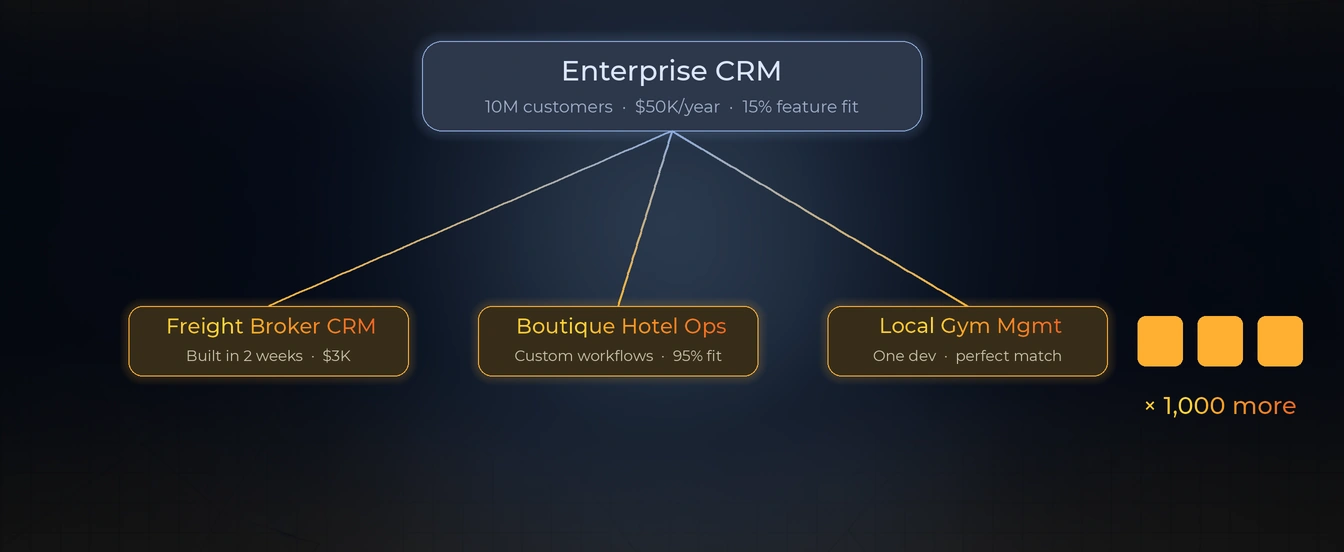
Take a 50-person logistics company. Today, they pay $50,000 a year for Salesforce. They use maybe 15% of it. What they actually need is a system that tracks driver relationships, freight broker interactions, and load-specific follow-ups — none of which Salesforce was designed for. But building a custom CRM used to mean a $500,000 project and a six-month timeline. So they live with Salesforce and duct-tape the gaps with spreadsheets.
That's not a technology problem. That's an economics problem. The demand exists. The cost to serve it didn't make sense.
AI changes the economics.
That same company now has one AI-savvy developer who builds exactly what they need in two weeks. Driver relationship tracking. Automated follow-ups tied to load status. Freight broker scoring. No unused features. No $50k annual license. A tool that fits 95% of their needs instead of 15%.
And the 12-person freight brokerage down the road — the one that can't even afford a developer? Now there's a 4-person shop that builds custom logistics CRMs for small freight companies. A niche that Salesforce would never enter. A business that could never have existed before because the market was too small and the cost too high.
That's the Jevons move. The cost drops. The threshold drops with it. A million projects that were never viable suddenly are. The market doesn't consolidate. It fragments. And it explodes.
Evaporation, Not Disruption
Disruption
A competitor takes your customers
 Your company
Competitor
Your company
Competitor
You can see it. You can fight it.
Evaporation
Customers never arrive in your universe
 Your company
You can't fight what you can't see.
Here's the part that should worry incumbents.
No single one of these new players competes with Salesforce. The 50-person logistics company isn't trying to beat Salesforce. The 4-person niche shop isn't positioning against Salesforce. They're not even thinking about Salesforce.
But a million of them, combined, do compete. And it's uneven.
Because Salesforce can't respond. There's no product roadmap that addresses a million niches. There's no sales team that sells to companies building their own tools. The threat isn't a competitor — it's evaporation. The addressable market quietly disappears, one small company at a time, each solving its own problem, none of them even aware they're part of a pattern.
That's worse than disruption. Disruption you can see. You can acquire it, copy it, fight it. Evaporation is invisible until the revenue starts declining and there's nobody to point at.
The Numbers Say It's Already Starting
This isn't a prediction. The data says it's underway.
The cost of running a model at GPT-3.5's level fell more than 280-fold in two years. 78% of developers worldwide now use AI coding tools. Merged pull requests on GitHub grew 29% year-over-year. New app submissions to Apple's App Store grew 24% in 2025. Meanwhile, more than 80% of manual business processes still run on spreadsheets — each one a shadow software product waiting to be replaced by something purpose-built.
The cost is collapsing. The building has started.
The demand was always there. The audiences always existed. The cost just finally dropped low enough to serve them.
The question isn't whether your market fragments. It's whether you'll notice the evaporation before it's too late.
Next week: what actually happens to incumbents when this hits — and the four paths that determine who survives.
Sources
- W. Stanley Jevons, The Coal Question, 2nd edition (1866), chapter VII: coal output of about 10.2 million tons in 1801 and 92.8 million in 1864. Library of Economics and Liberty: econlib.org
- U.S. Small Business Administration, Office of Advocacy, Frequently Asked Questions About Small Business, 2026 (3 February 2026): 36,207,130 small businesses, data year 2022. advocacy.sba.gov
- Salesforce, Sales Cloud pricing: Pro Suite at $100 and Enterprise at $175 per user per month, billed annually. salesforce.com
- Stanford HAI, AI Index 2025: State of AI in 10 Charts (7 April 2025): GPT-3.5-level performance fell from $20 to $0.07 per million tokens between November 2022 and October 2024. hai.stanford.edu
- Stack Overflow, 2025 Developer Survey, AI section (29 July 2025): 78.5% of respondents currently use AI tools in their development process. survey.stackoverflow.co
- GitHub, Octoverse 2025 (28 October 2025): 518.7 million pull requests merged, up 29% year over year. github.blog
- Appfigures (5 December 2025): about 557,000 new App Store app submissions in 2025, up 24% on 2024. appfigures.com
- PwC UK with Alteryx (2023): "over 80% of manual business processes are still utilising spreadsheets". pwc.co.uk
First published in Uncomplicated, Nicolas's newsletter on LinkedIn. Figures updated since the LinkedIn edition.
More from the blog